
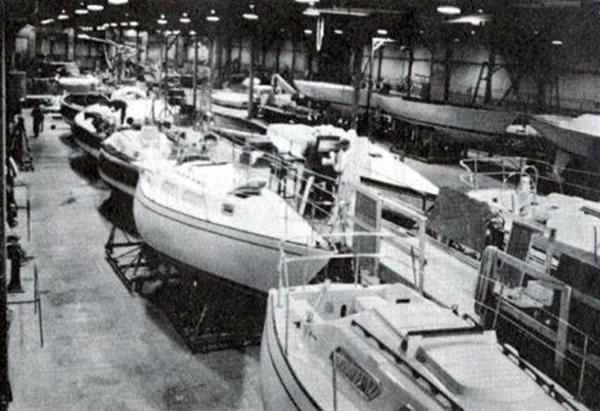
 Hughes Boat Works
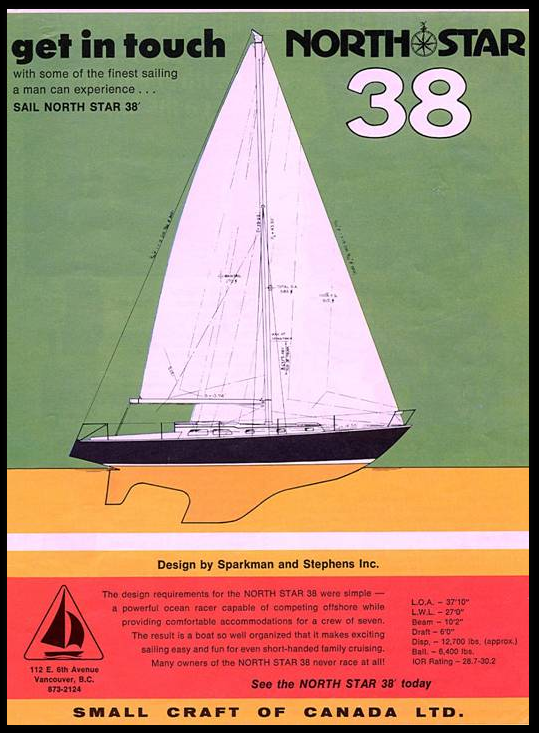 H38 Advertisement
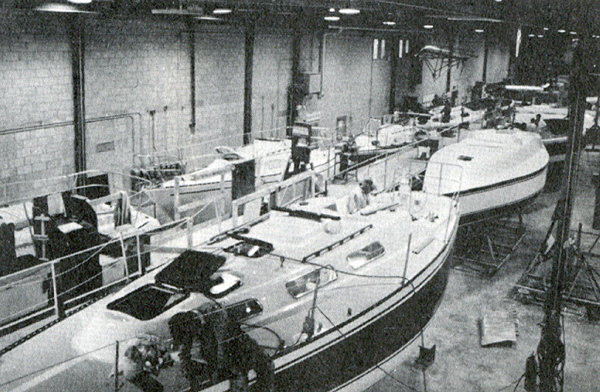 Hughes Boat Works
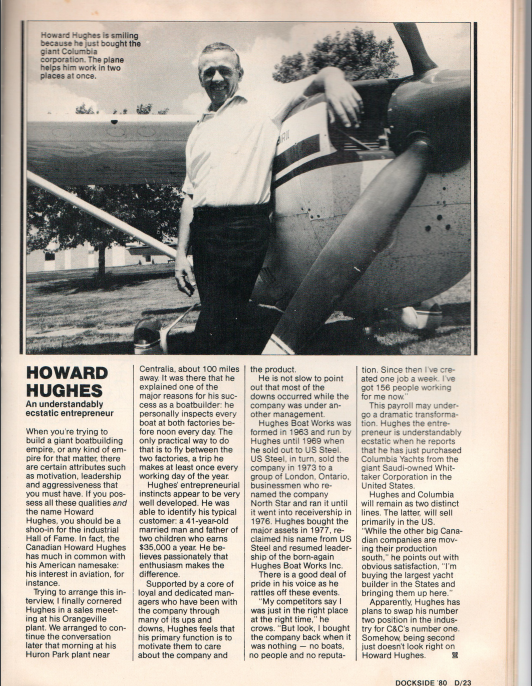
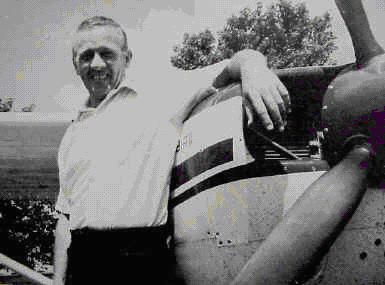 Howard Hughes
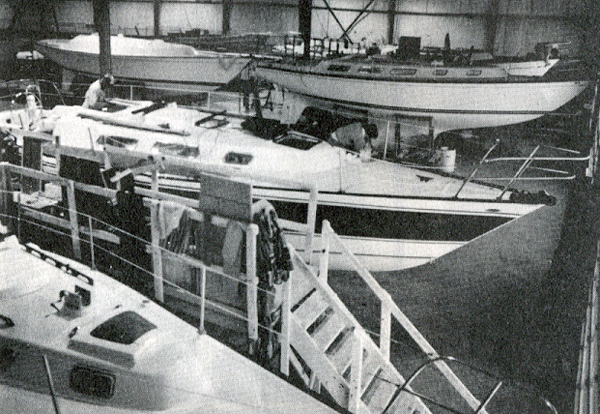 Hughes Boat Works
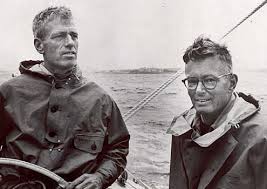 Rod and Olin Stephens
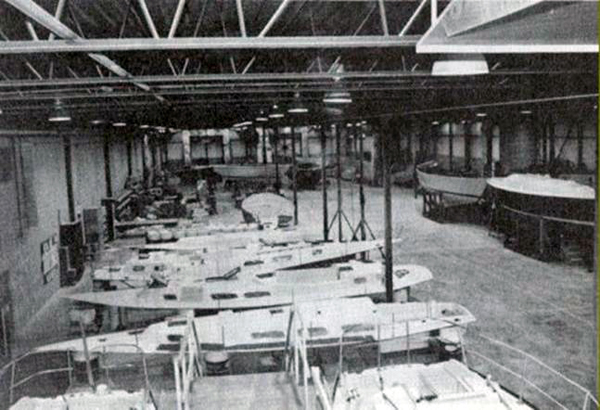 Hughes Boat Works
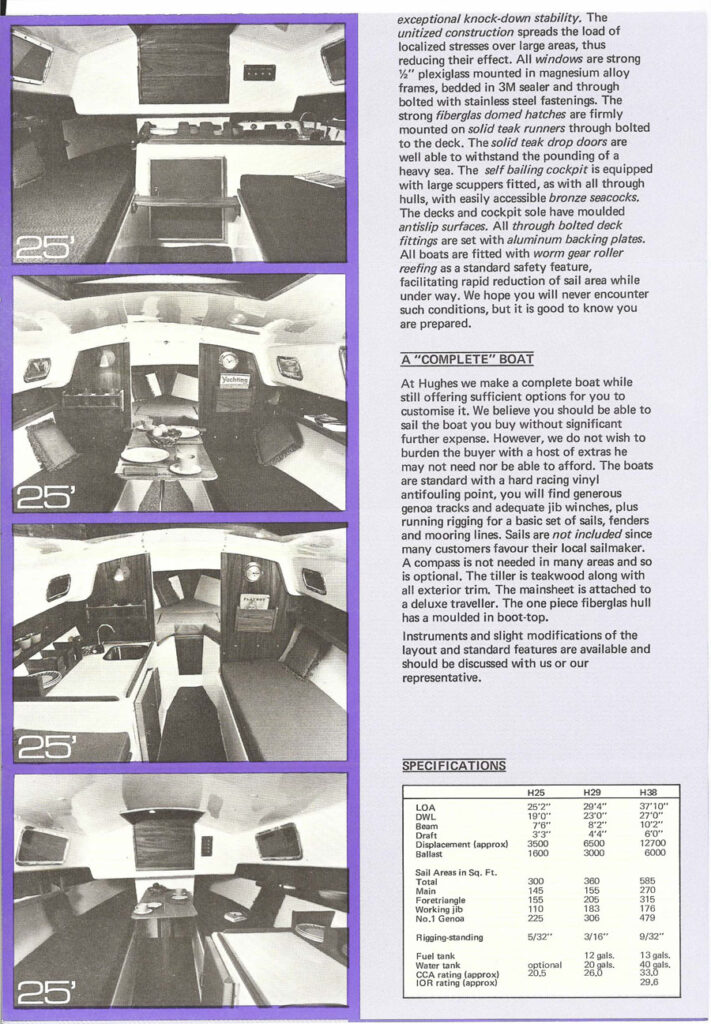
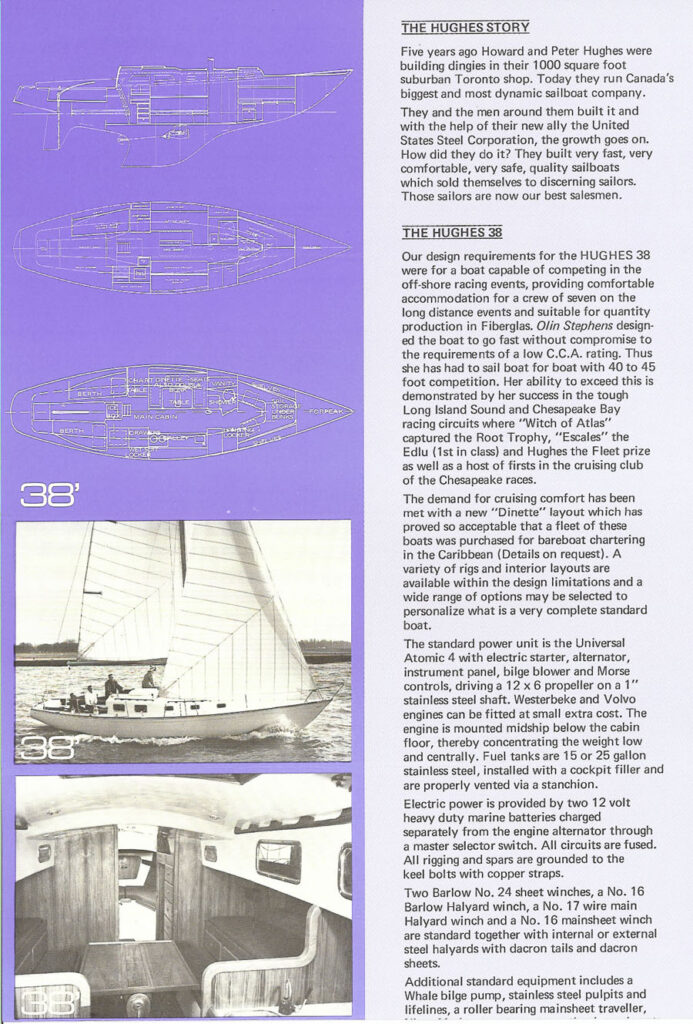
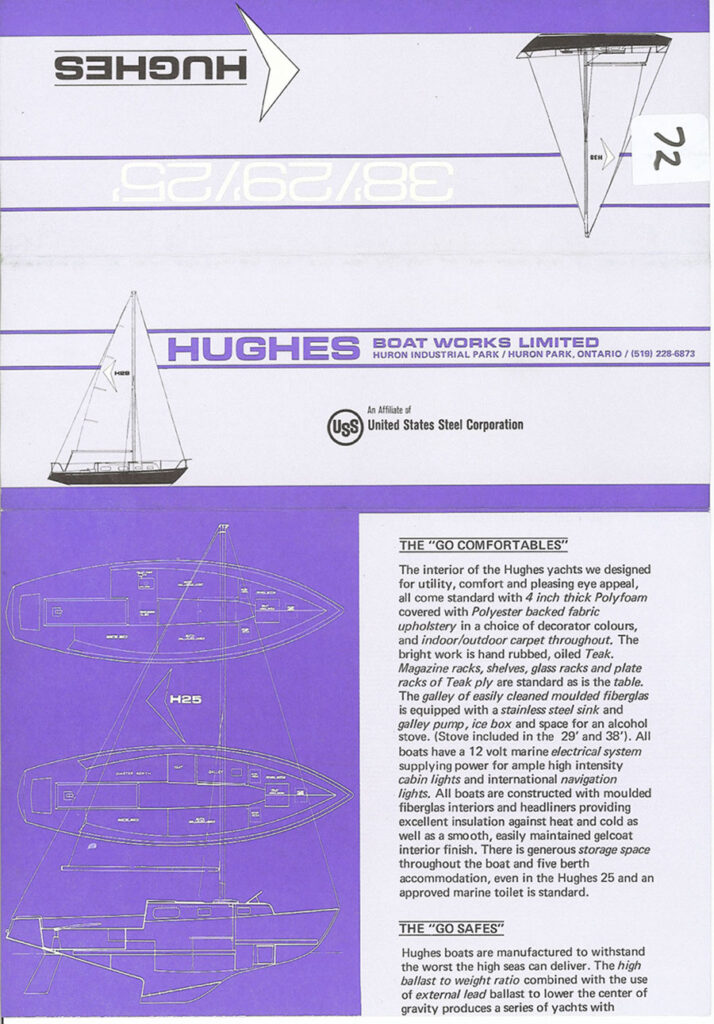
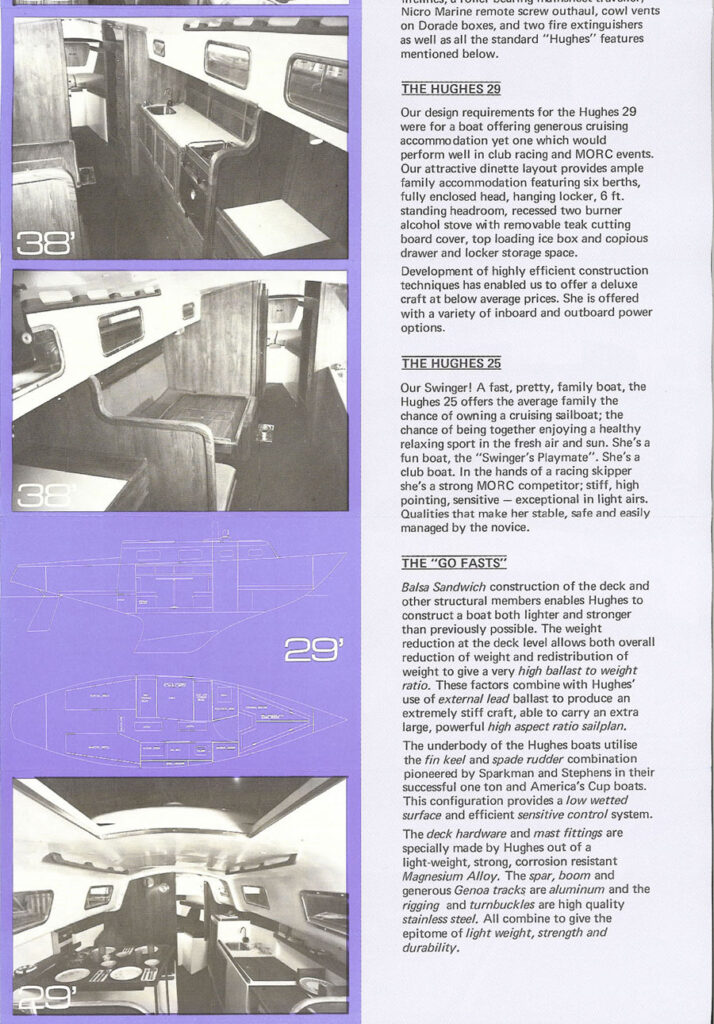
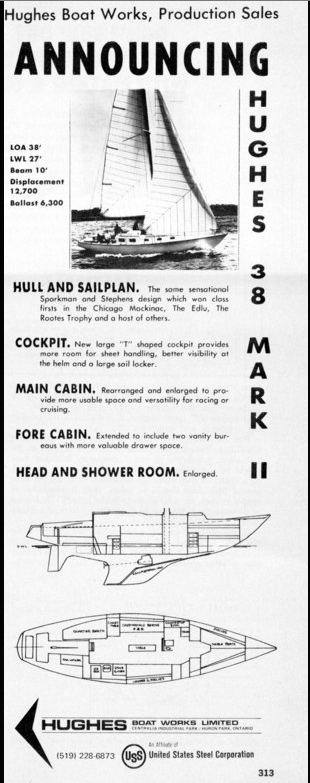 H38 Flyer
Founded in Willowdale, Ontario (a suburb of Toronto) as a partnership between brothers Howard and Peter Hughes.
The company’s earliest production focused on small boats, beginning with 8- to 16-foot dinghies, including designs such as El Toros and 505s.
Hughes Boat Works relocated to Scarborough, Ontario, operating from facilities on Munham Gate.
During this period:
- Tooling for the Hughes 24 was purchased from Tanzer
- The Hughes 27 was designed by Howard Hughes (1965–1966)
- Sparkman & Stephens were approached in 1966 to design what would become the Hughes 38 (Design #1903)
Approximately 20 Hughes 27s were built at the Scarborough facility before the company moved its full manufacturing operation to Huron Park, Ontario (then known as Centralia). The Hughes 27 remained in production there until it was replaced by the Hughes 29.
Hughes Boat Works Limited was formally incorporated on February 23, 1967, for the “undertaking of the manufacture of pleasure boats.”
The company was registered as Ontario, Canada Corporation #200854.
Expansion
Production moved to Centralia, Ontario, a former Royal Canadian Air Force Commonwealth Air Training Plan airfield near Exeter. After World War II, the site was converted into an industrial park and renamed Huron Park.
The Hughes factory occupied a large building near the center of the former ground-side hangars (now the site of Exeter Machine) and included an outdoor test tank pool.
Models Produced
During this period, Hughes produced:
- Hughes 22
- Hughes 25
- Hughes 29 (all designed by Howard Hughes)
- Hughes 38
- Hughes 48 (S & S Design #1956, jointly developed)
Note: Hughes also produced Hughes 38 hulls for Hinckley Yachts, who fitted their own decks and interiors and marketed the boat as the Hinckley 38. The Hughes 48 was originally designed for Seafarer, which was unable to continue production.
Corporate Change
During this time, Hughes Boat Works became a division of United States Steel Corporation. Both Howard and Peter Hughes remained with the company.
Leadership & Ownership
Howard & Peter Hughes leave the company.
U.S. Steel changes the company name to Northstar Yachts Ltd.
Design & Production
The Northstar line of sailboats was built to plans commissioned by Hughes Boat Works, most drawn by the design team of Sparkman & Stephens.
- Northstar 500 (25 ft) → later NS600 (S&S design #2135)
- Northstar 1000 (30 ft, ½ ton) – S&S design #2098-C6
- Northstar 1500 (35 ft, ¾ ton) – S&S design #2166
- Northstar 38 and Northstar 80/20 (41 ft) – S&S design #2134
- The Bruce Farr–designed NS727 (24 ft)
- N900 (30 ft)
Either the Northstar 500 or the NS727 won the ¼-ton world championship.
Market Context
At the time, the Canadian dollar was worth slightly more than the U.S. dollar, making pricing effectively equivalent in both markets. In 1973, the retail price of a Northstar 500 with standard options was $CAD 11,004, FOB Huron Park.
The annual information return dated February 23, 1975 lists four Canadians and three Americans as directors.
The American directors — J.T. MacKenzie, D.F. Tuthill, and D.M. McAvity — held the roles of President, Secretary, and Treasurer respectively (possibly U.S. Steel directors).
Corporate records list December 10, 1975 as the cancel/inactive date.
Howard Hughes purchased the assets of Northstar, and the company name was changed back to Hughes Boatworks Inc.
During this period, Hughes sold the Farr-designed tooling (producing only a small number of boats), choosing to focus on family cruisers rather than racing designs.
Model Evolution
- The NS600 was modified to become the H26, and a new model, the H27, was introduced.
- The NS1000 was modified to become the H31 by rolling out the hull sides and stretching the transom.
- The NS1500 was renamed the H35, and the NS80/20 became the H40.
- Hughes also sold H40 hulls to Tartan Yachts, who—like Hinckley with the 38—produced their own deck and interior.
Columbia Collapse
In 1978, Columbia Yachts (which had absorbed Coronado Yachts) ceased operations. Contemporary accounts cite labour problems, though cash-flow constraints may have been the decisive factor. Columbia reportedly sold approximately $250,000 worth of parts to a marina in Virginia to cover payroll and operating expenses.
Acquisition
In 1979–1980, Hughes purchased Columbia Yacht Corporation, one of the world’s largest sailboat builders at the time, and consolidated production at the Huron Park facility in Centralia, Ontario. The company was renamed Hughes–Columbia Inc.
Product Continuity
During this period, the Hughes–Columbia 36 (designed by W. Tripp Sr.) was launched alongside continued production of existing models, including the H31, H35, H38, and H40 (ketch). Additional production included Alan Payne–designed motor-sailers and larger cruising yachts. All models were offered either fully finished or in kit form.
Hughes–Columbia entered receivership, largely attributed to debt incurred during the acquisition of Columbia Yacht Corporation, followed closely by a deep recession and historically high interest rates that significantly reduced demand for new sailboats.
Later that year, Aura Yachts assumed control of Columbia. According to the U.S. Coast Guard, Columbia’s Manufacturer Identification Code (MIC), CLY, was retired on August 28, 1982.
Under Aura Yachts, production of the Hughes 35 continued. The Hughes 35 was also built in Great Britain by South Hants Engineering (marketed as the S.H.E. 36). South Hants Engineering may also have produced a limited number of Northstar 1500s. The final recorded hull number is believed to be 102.
In 1986, Howard Hughes, with several partners, again purchased assets following the failure of Aura Yachts and focused primarily on producing custom-built H40 yachts at the Orangeville facilities.
Hughes Boat Works diversified into the manufacture of large, one-piece fibreglass swimming pools. The venture proved commercially successful; however, a fire later destroyed the factory. The company’s insurer, Firestone Insurance, was subsequently found to be fraudulent, leaving Hughes without compensation.
By this point, most tooling for the sailboat production had already been moved out of the plant, where it is believed to remain to this day.
Hughes Boat Works Ltd. Was the largest sailboat manufacturer in Canada for many years, building a total of approximately 3,500 boats. During the company’s peak years it employed 250 to 300 staff.
Howard Hughes reflecting on his earlier designs:
“While the Hughes 27 and Hughes 29 are very different boats they share very similar hull lines with the exception of below waterline. The Hughes 27 was an older concept long keel design with the rudder attached to the aft end of the keel which had been the norm at the time. During the 1965 to 1969 period the concept of fin keels or separate keel and rudders was developed primarily by Sparkman and Stephens and George Cuthbertson of C&C and most production boats since then have been in that configuration.“
Speaking of the special relationship between Hughes Boatworks and Sparkman and Stephens:
“We worked very closely with S&S for many years and truly honed our production boatbuilding skills with a lot of personal input from Olin J Stephens and Rod Stephens. Olin and Rod became my very good friends during those seminal years in the industry and acted as our mentors passing on the lessons learned over many years designing the most successful boats ever. Olin passed away last year (2008) at 100 with Rod a few years ago in his very late nineties. They were the very best and I learned a great deal about building boats and life in general from both“