
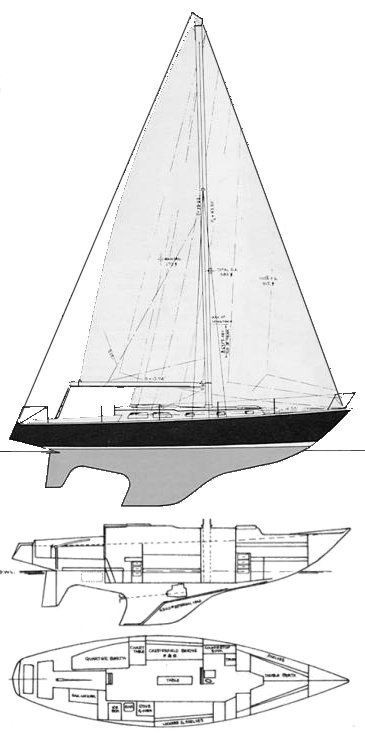
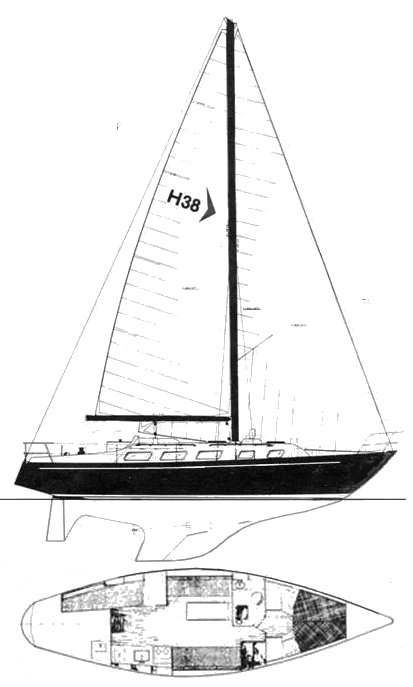
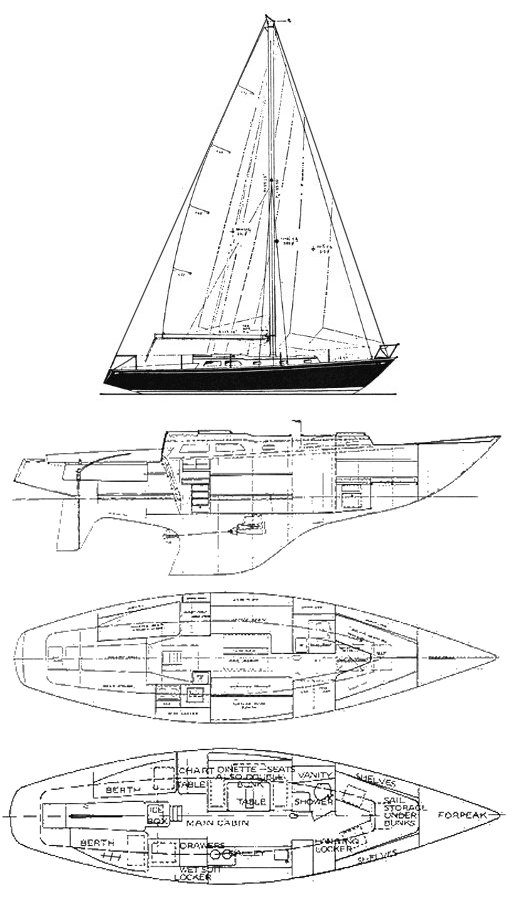
The Hughes 38 is a classic offshore sailboat designed by Sparkman & Stephens and built in Canada by Hughes Boat Works during the 1970s. Conceived at a time when performance, balance, and seaworthiness were primary design goals, the Hughes 38 reflects the transition between traditional cruising yacht proportions and the emerging ideas that would later define modern racer-cruisers.
Built to the Cruising Club of America (CCA) rule, the design features long overhangs, a relatively narrow beam, a fin keel, and a separate rudder. These characteristics contribute to the boat’s reputation for good manners at sea, predictable handling, and strong upwind performance — qualities that continue to be valued decades after her introduction.
Over the years, Hughes 38s have been actively cruised, raced, modified, and maintained by owners around the world. While individual boats often differ in rig details, systems, and interior layouts, the underlying design has proven adaptable to a wide range of sailing styles, from club racing to offshore passagemaking.
This site exists to document the Hughes 38 as a design and as a living fleet — collecting historical material, owner knowledge, technical references, and firsthand experience. It is not intended as a definitive authority, but as a shared resource that reflects how these boats have been built, used, and cared for over time.
Sparkman & Stephens Heritage
The Hughes 38 is part of a broader family of yachts designed by Sparkman & Stephens, whose work dominated offshore and ocean-racing design through the mid-20th century. During this period, S&S designs were widely adopted by multiple builders, reflecting both the firm’s influence and the durability of its design philosophy.
Core characteristics associated with S&S designs of this era — moderate displacement, fine forward sections, balanced sail plans, and attention to offshore behavior — are clearly evident in the Hughes 38. These qualities placed the boat within a lineage that emphasized predictability, balance, and performance under rating rules that rewarded seaworthiness as much as speed.
Comparable designs from the same period, including the Swan 38 built by Nautor Swan, share similar proportions and design intent, even where construction standards, finish levels, and market positioning differed. While these boats are not identical, their similarities reflect common priorities rather than coincidence: efficient hull forms, disciplined geometry, and a focus on sailing qualities that extend beyond protected waters.
In this context, the Hughes 38 can be understood as an accessible expression of a well-established design language — one that values offshore capability and balanced handling, and that continues to reward attentive sailing decades after launch.
Why the Hughes 38?
The Hughes 38 has earned a loyal following because it sits in a rare middle ground: a classic Sparkman & Stephens design with genuine offshore manners, strong windward ability, and a hull that remains efficient and rewarding to sail decades after launch. Owners value the boat not because it is the biggest, fastest, or roomiest 38-footer, but because it tends to do the important things well—especially when conditions are less than ideal.
Windward ability as seamanship
A recurring theme among offshore sailors is that speed and pointing ability are not just performance metrics—they can be safety tools. As John Rousmaniere notes in Desirable and Undesirable Characteristics of Offshore Yachts, the ability to make miles to weather can matter when trying to reach shelter before a gale or when working off a lee shore. The Hughes 38 is widely regarded as a strong upwind boat for her size and era, with a hull form that remains composed in chop.
Balance and behavior at sea
Owners often describe the Hughes 38 as stable and “honest” in the way she tracks and carries sail. The combination of narrow beam, fine ends, and moderate proportions tends to produce a ride that is less abrupt than many flatter, wider modern hulls—particularly when the sea state is up and the boat is asked to work.
Practical sail plan and short-handed handling
Although nearly 40 feet overall, the Hughes 38 has an easily driven hull and a sail plan that many owners find manageable with a small crew—or solo—especially with modern conveniences like roller furling. The relatively modest mainsail and large foretriangle can also lend flexibility for owners who choose to adapt the rig to their sailing style.
A durable platform—plus the usual refit realities
The Hughes 38 has a reputation for solid basic construction for the era, and many boats remain actively sailed and refit today. At the same time, these are 1970s production boats: deck core work, chainplate structure, mast step condition, and deck hardware bedding are common focus areas during restoration. A good survey and a realistic refit plan matter more than marketing claims or nostalgia.